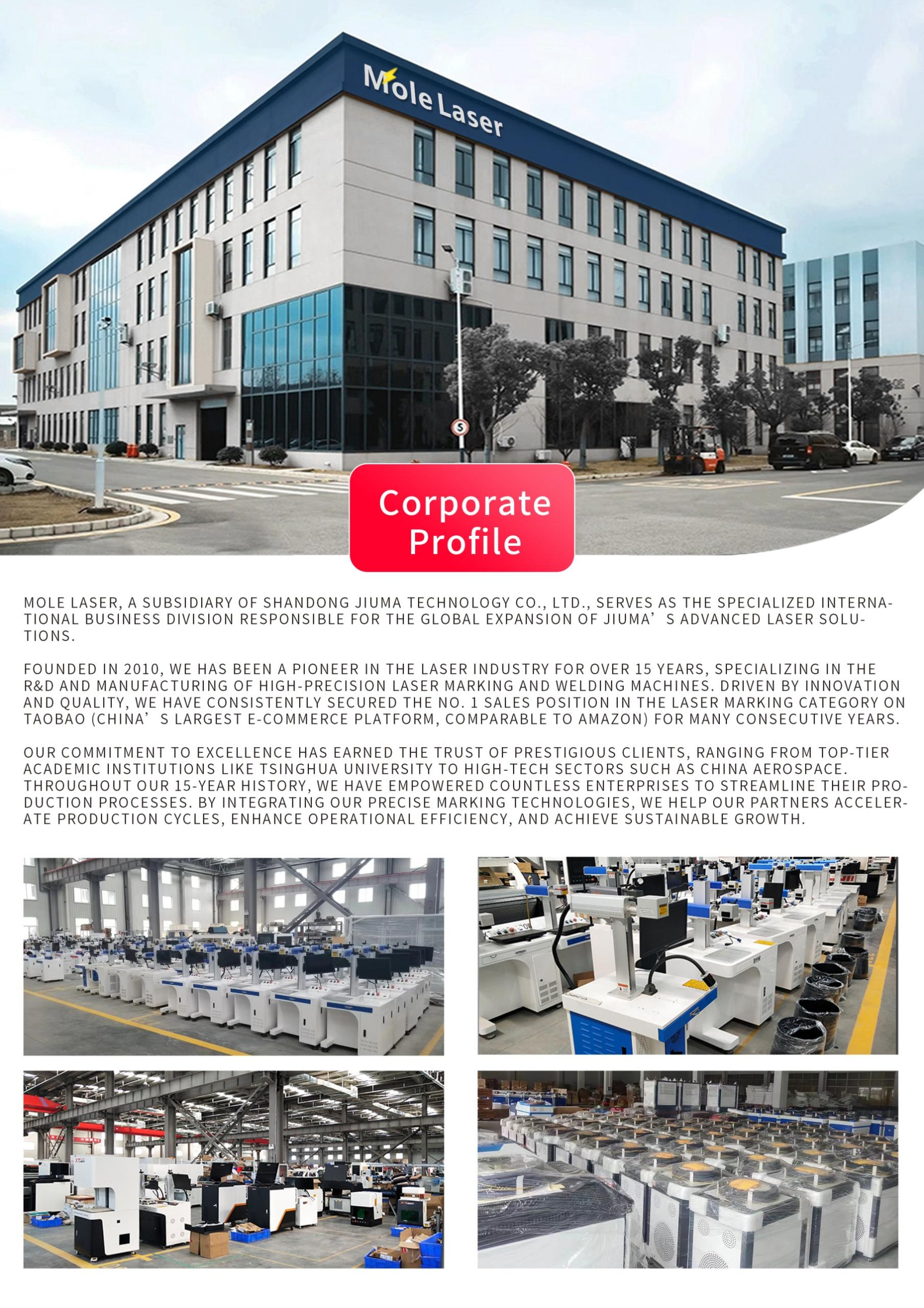
MOLE LASER
- FIBER MARKING
- CO2 MARKING
- UV MARKING
- VISION FLY MARKING
- PORTABLE MARING



keeping the working environment clean and healthy

ComputerPortable control terminal for parameter setting, program editing and real-time monitoring

Provides physical and laser radiation protection, isolating operators from laser hazards and dust

Enables 360°circular marking on cylindrical workpieces such as pipes, rings

MOLE LASER
This is the "workhorse" of the industrial world. It uses a fiber laser to create high-contrast marks through heat.
Suitable Materials: Primarily metals (stainless steel, aluminum, brass, titanium) and some engineered plastics.
Application Scenarios: Ideal for permanent serial numbers, barcodes, and logos on automotive parts, electronic components, hardware tools, and medical devices
This machine uses Co2 laser source. It is the go-to solution for non-metallic surfaces.
Suitable Materials: Non-metallic materials such as wood, acrylic, glass, paper, textiles, leather, and rubber.
Application Scenarios: Widely used in food and beverage packaging (date codes), craft gifts, leather shoe processing, and wooden furniture branding.
Known as the "cold marking" source, UV lasers have a very short wavelength, allowing them to mark without damaging the material's surface with heat.
Suitable Materials: High-end plastics, glass, silicon wafers, and delicate electronics.
Application Scenarios: Perfect for "damage-free" marking on cosmetic bottles, pharmaceutical packaging, and micro-chips where precision and aesthetics are critical.
This isn't just about the laser source; it's about the automation system. It combines a laser (usually Fiber or CO2) with a camera (Vision) and a conveyor belt (Flying).
Suitable Materials: Depends on the laser source equipped, but generally used for mass-produced items.
Application Scenarios: High-speed assembly lines. The vision system detects the position of moving objects, and the laser marks them "on the fly" without stopping the belt. Common in the bottling and cable industries.
Unlike the others, this is a mechanical process. It uses a computer-controlled high-frequency vibration needle driven by compressed air to "dot" the surface.
Suitable Materials: Hard materials, mostly heavy metals and hard plastics.
Application Scenarios: Deep marking for heavy-duty environments. It’s used for VIN numbers on vehicle frames, large pipes, and engine blocks where the mark must remain legible even after painting or heavy wear.